Why homeowners in 77459, 77489, and 77071 call us first
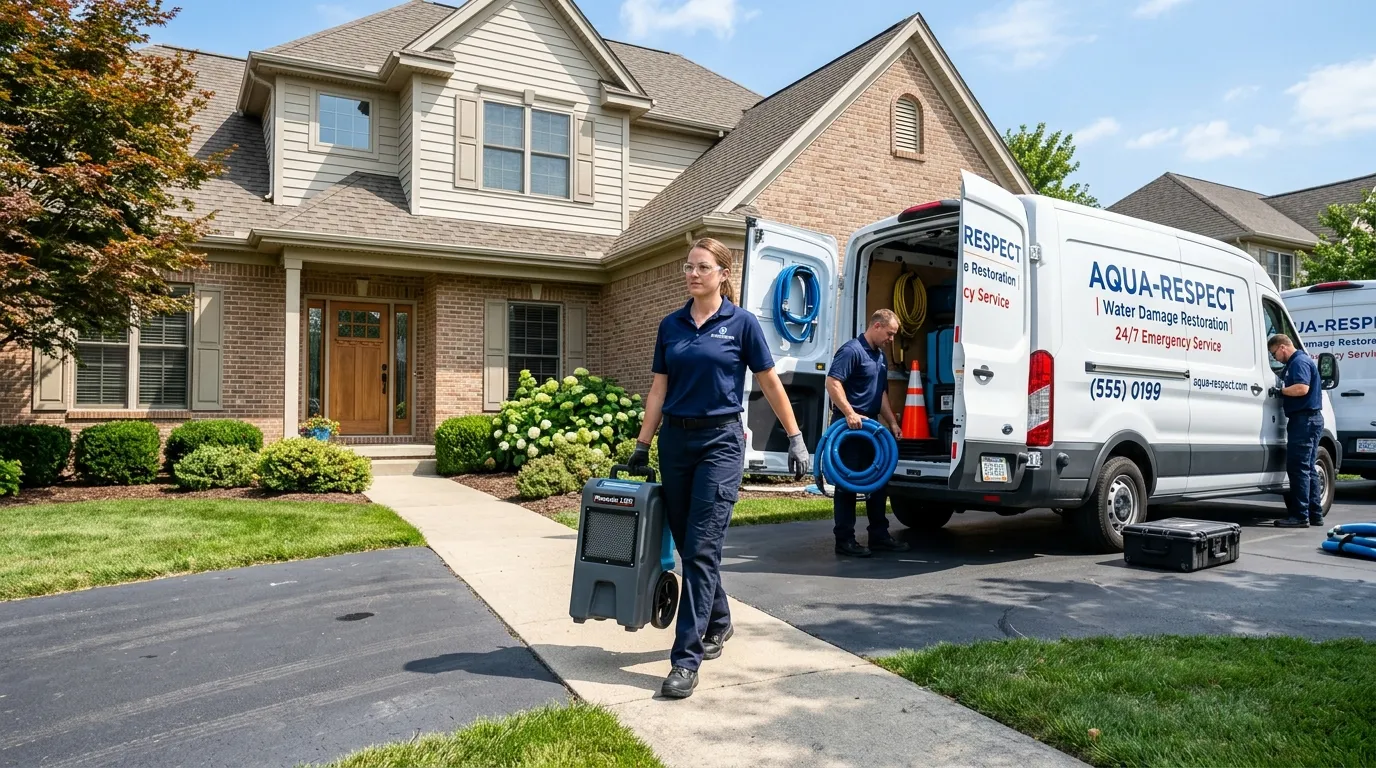
Our trucks stage inside Missouri City. Our dispatchers know which Sienna villages flood first, which Quail Valley streets back up during heavy rain, and which carriers in this market actually pay on time. National brands dispatch from Beltway depots and quote 90 to 240 minute arrivals on a normal Tuesday. We hit 60 minutes or less on more than 9 out of 10 calls because we are already here when your phone rings.
We answer the phone live. Not a call center, not voicemail, not a chatbot. The person who picks up routes a crew leader to your address within minutes and stays on the line while you shut off your main supply valve. The crew arriving in your driveway is the same crew working your job a week later. No subcontractors, no scope handoffs, no second company you have to chase for warranty work.
Real costs in Missouri City, not national averages
What a job actually runs across 77459, 77489, and 77071:
- Single-room Cat 1 water damage (clean supply leak caught fast): $1,800 to $4,500.
- Whole-floor Cat 1 to Cat 2 damage (washing machine, dishwasher, water heater failure): $4,500 to $14,000.
- Cat 3 sewage backup with limited demolition: $3,500 to $9,000.
- Whole-home flood from a Brazos overflow or hurricane surge: $25,000 to $80,000+.
- Single-room mold remediation under S520 protocol: $2,000 to $6,000.
- Partial-home fire and smoke restoration: $8,000 to $45,000.
Written estimates before equipment is set. Insurance billed direct in Xactimate format on most jobs. You pay your deductible, not the full ticket.
Your neighborhood, your failure pattern
A Sienna leak and a Quail Valley leak do not look the same. Knowing the difference shortens diagnosis and lowers the bill.
Sienna and the Sienna villages. Anderson Springs, Avalon, Bees Creek, Brushy Lakes, Hidden Hollow, Sawmill, Sienna Point, Shipmans Landing, Silver Ridge, Waters Lake, and Avalon at Sienna are post-1990s slab-on-grade builds with long copper and PEX supply runs through unconditioned attic space. A single freeze in February 2021 ruptured dozens of supply lines across these villages in one weekend. We know the failure points.
Quail Valley. Original 1970s construction. Cast-iron drain stacks past service life. When one fails, sewage surfaces at the lowest fixture, usually a slab-level guest bath. The right response is biohazard containment plus a plumber's stack inspection so you do not re-flood three months later.
Lake Olympia. Waterfront lots sit close to the water table. Wind-driven rain during named storms and surge during hurricanes are the recurring intrusion paths. NFIP coverage is not optional here.
Riverstone and the Brazos corridor. Sections inside FEMA flood zones AE and X-shaded need flood documentation that differs from a standard property claim. We document elevation, waterline marks, and contamination evidence for FEMA adjusters on every job in these zones.
Dry Creek Village and older Missouri City. Mature trees, original galvanized supply lines, and 30+ year old roofs. Summer storm roof leaks account for a steady stream of attic and ceiling work in these blocks.
What your Texas homeowners policy actually covers
Most standard HO-3 policies sold in Missouri City cover sudden, accidental water from plumbing, appliances, and HVAC systems. They do not cover long-term seepage, pre-existing damage, or rising water of any kind. That last one is where homeowners get hurt: hurricanes, bayou overflow, river flooding, and storm surge are flood by Texas legal definition, and flood requires a National Flood Insurance Program policy or a private flood rider.
Three coverage gaps trip up Missouri City homeowners more than any others:
- No sewer and drain backup endorsement, or limits set at $5,000 when the actual cost runs $15,000.
- Mold sub-limits capped at $5,000 to $10,000 without an additional rider.
- Assuming flood is included when it never has been.
We read your declarations page on every job before submitting scope. No surprises at settlement. Texas statute of limitations on most weather-related claims is one year from the date of loss under House Bill 1774. Do not sit on hail or wind damage. File early.
The first 10 minutes, before we arrive
Three actions, in this order:
- Shut the water off. Main supply valve at the meter, fixture stop valve under the sink or toilet, or the breaker for an electric water heater. Stopping the flow saves more than any other single decision.
- Move what is portable to a dry area. Lift skirts and box springs off wet carpet. Get electronics, paper, and keepsakes out of the wet zone.
- Photograph everything. Wide shots and close-ups. Before you touch anything. Insurance documentation starts with what the damage looked like at discovery, not after mitigation.
Then call (832) 479-4406. We dispatch 24 hours a day, every day of the year, including holidays and named hurricanes. Average arrival anywhere in Missouri City is 60 minutes.
Equipment matched to Gulf-Coast humidity
A row of box fans does not dry a Missouri City structural cavity. Houston's 75 to 90 percent relative humidity stalls standard refrigerant dehumidifiers right where the drying job actually finishes. What we bring on every call:
- Truck-mounted extractors. Roughly 10x the per-minute volume of a portable unit. Critical in the first four hours.
- Low-grain refrigerant (LGR) dehumidifiers. Pull moisture below 40 grains per pound, where standard units quit.
- Axial and centrifugal air movers. Sized to IICRC standard of one mover per 50 to 75 square feet of wet surface.
- Calibrated moisture meters and thermal imaging. Daily psychrometric logs prove drying progress.
- HEPA negative-air machines. Required for any S520 mold containment.
The right equipment is the difference between a dry house in five days and a mold remediation in five weeks.
Certifications, and what they mean for your claim
- IICRC S500. The water damage standard. Every crew leader carries it.
- IICRC S520. The mold remediation standard. Required for any job over 25 contiguous square feet of mold in Texas.
- IICRC S700. Fire and smoke restoration. FSRT-certified.
- TDLR Mold Remediation Contractor. Texas Department of Licensing and Regulation license on file.
- Xactimate-trained estimators. Texas carriers expect line-item estimates in Xactimate format. We write them.
- EPA RRP. Lead-safe work practices for any home built before 1978.
- OSHA-trained crews. Confined-space, biohazard, and PPE protocols.
- Fully insured. $2M general liability, workers comp on every crew member.
If a contractor will not list these in writing, walk away. Water damage is the easiest market in restoration for unqualified operators to enter and the hardest one to fix after a bad job.
Same crew from extraction through rebuild
Most national franchises hand your job to three companies: one for mitigation, one for mold, one for reconstruction. Every handoff is a chance for scope to drop, schedules to slip, and warranty responsibility to go missing. We run the entire chain in-house. The same project manager who meets your adjuster on day one walks the final punch list on day forty.
That means one phone number for status. One scope of work. One warranty. And no finger-pointing when a baseboard reveals a moisture pocket the demo crew missed. If we miss something, we come back and fix it on our dime.
What we tell homeowners we cannot do
Honesty beats over-promising. We will not:
- Promise a final dry time without first taking moisture readings on your specific structure.
- Write an estimate that hides line items the carrier will reject.
- Talk you into a full tear-out when a Cat 1 in-place dry will hold.
- Quote roof or plumbing repair we are not licensed to perform. We coordinate trusted local trades and stay on schedule.
- Take a job where the right answer is "your insurance covers this and your regular contractor can handle it."
If we are not the right call for your loss, we will say so on the first phone call and point you somewhere that is.
60-minute response, what that actually means
It is an average we measure, not a marketing line. Our 12-month rolling average on dispatch-to-arrival across Missouri City sits at 58 minutes door-to-door from first ring. Storm events with heavy call volume stretch that to 90 to 120 minutes, and during a named hurricane we triage life-safety and active flooding first. Outside those windows, we hit 60 minutes or less on more than 90 percent of calls.
A franchise dispatched from north Houston runs 90 to 240 minutes on a good day. On a bad day, the truck never arrives at all because three earlier jobs ran long. That does not happen here because the crew assigned to your address is already inside Fort Bend County when you call.
One number, 24 hours a day: (832) 479-4406. Free written estimate. Direct insurance billing. Request a callback if it is not an active emergency.