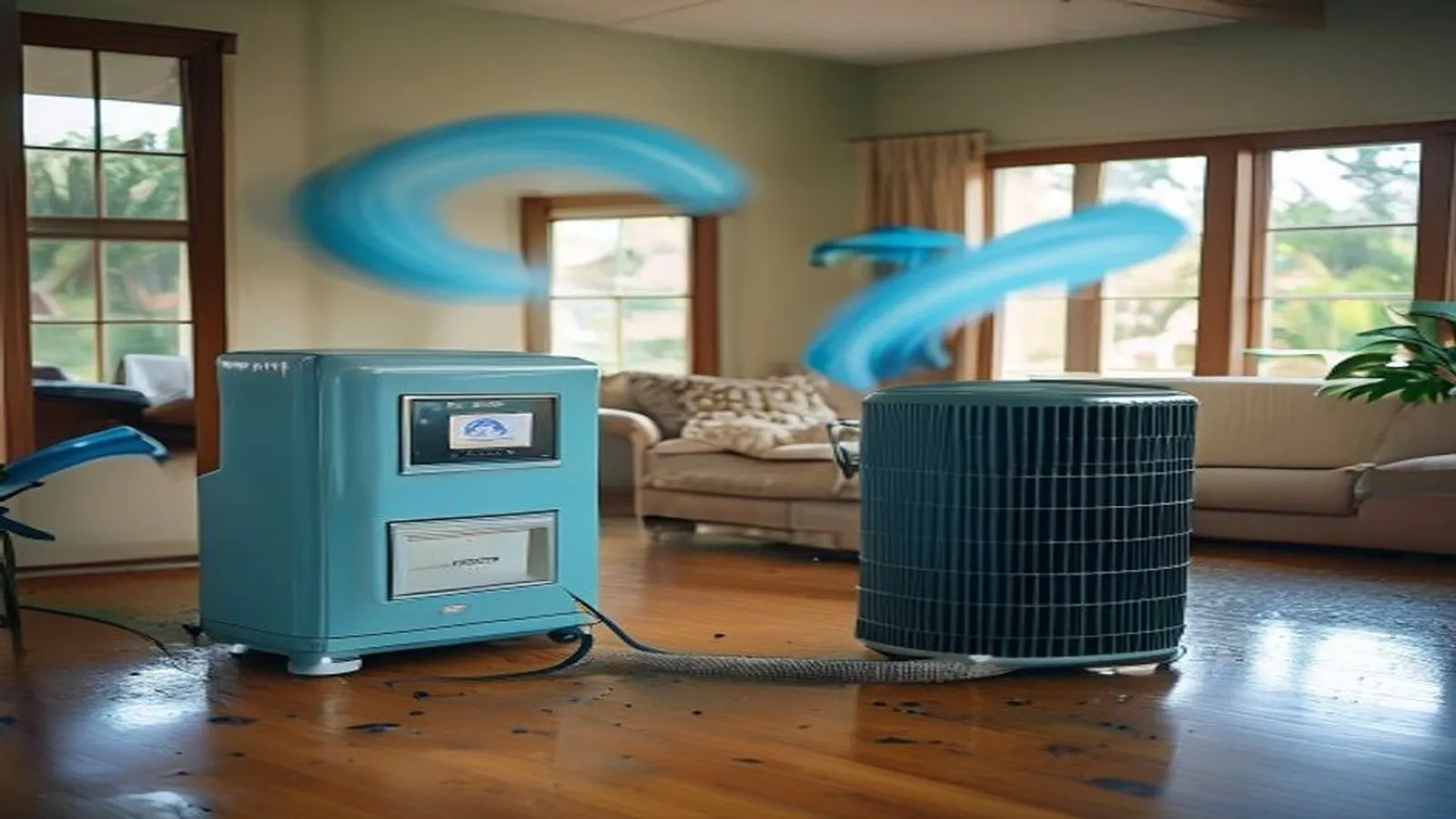
The standard advice after any small water leak is to set up a couple of fans and a dehumidifier and let things dry out. In drier climates that approach works. In Missouri City, with ambient humidity routinely above 75 percent, the math does not work and the materials never reach drying equilibrium. Here is why, and what the restoration industry uses instead.
The dew point problem
Dehumidifiers extract water from air by condensing it on a cold coil. The colder the coil and the wetter the air, the more water extracted. Standard refrigerant dehumidifiers are designed for indoor conditions in moderate climates — they pull moisture efficiently when the air is around 60 to 70 percent relative humidity at room temperature.
The problem starts when the air gets dry enough that the dew point drops below the operating range of the unit. At roughly 40 grains of moisture per pound of air (the standard restoration measurement unit), a typical home refrigerant dehumidifier stalls. The coil cannot get cold enough to condense more water without freezing over. The unit runs but the output drops to near zero.
And 40 grains per pound is exactly where drying actually has to finish. Materials reach drying equilibrium when surrounding air is below that threshold. A standard dehumidifier gets you most of the way and then quits at the worst possible moment.
Why this matters in Missouri City specifically
Houston metro ambient conditions push standard dehumidifiers harder than almost anywhere else in the continental US. Summer dew points routinely hit 75°F outdoors. Even with air conditioning, indoor relative humidity often runs 55 to 65 percent in homes without dedicated dehumidification. After a water loss, the affected space is even wetter, and once the standard dehumidifier hits the dew-point wall, drying stops while materials are still holding enough moisture to support mold growth.
This is why properly run restoration jobs in Missouri City take 20 to 30 percent longer than the IICRC national average drying times. The math of the local climate demands it.
What LGR equipment does differently
Low-grain refrigerant (LGR) dehumidifiers are designed for restoration work. They use a heat-exchange pre-cooler before the main condensing coil. The pre-cooler drops the air temperature first, which lets the main coil run colder without freezing, which extends the productive operating range down to roughly 20 grains per pound — well below where standard units stall.
On a typical Missouri City restoration job, LGR units pull 12 to 20 gallons of water per day per unit through the productive humidity range. Standard refrigerant units in the same space might pull half that volume during the high-humidity early phase and effectively nothing during the late phase where drying actually has to finish. The difference is the difference between dry materials in five days and not-quite-dry materials in three weeks.
Air movers complete the system
Dehumidifiers cannot remove moisture they cannot reach. Air movers — large axial or centrifugal fans positioned at the IICRC standard of one mover per 50 to 75 square feet of wet surface — accelerate evaporation from materials into the air stream where the dehumidifier can capture it. The combination is the system. Running dehumidifiers alone is half a solution.
Why home equipment falls short even at small scale
Home dehumidifiers rated for 30 to 50 pints per day under ideal conditions typically deliver 15 to 25 pints per day in Houston-area summer conditions. A single LGR commercial unit delivers 120+ pints per day. For a single-room water loss, you would need 6 to 8 home units running continuously plus 4 to 6 fans to match what one commercial LGR setup does in the same space.
Why this matters for your insurance scope
Insurance carriers in Texas evaluate restoration claims partly on whether drying progressed at industry-standard rates. A scope that uses inadequate equipment produces a slow drying curve that adjusters can challenge as inefficient. The properly documented job uses LGR equipment, air movers, and daily psychrometric logs — and the documentation itself protects the claim from second-guessing.
For the specific equipment we bring to every Missouri City call, the truck-mounted extraction capacity, and how we log drying progress, see our water damage restoration page and our emergency extraction page.
If you have a small leak right now
For a small spill caught immediately, your shop vac and a window fan may genuinely be enough. For anything larger or anything wet enough to soak into carpet pad or drywall, call (832) 479-4406. The consultation is free and we will tell you straight whether you actually need us or whether you can handle it with home equipment.
Need restoration help in Missouri City right now? Call (832) 479-4406 — live answer, 24/7. Or see our full restoration services, the rest of the blog, or the service area map.