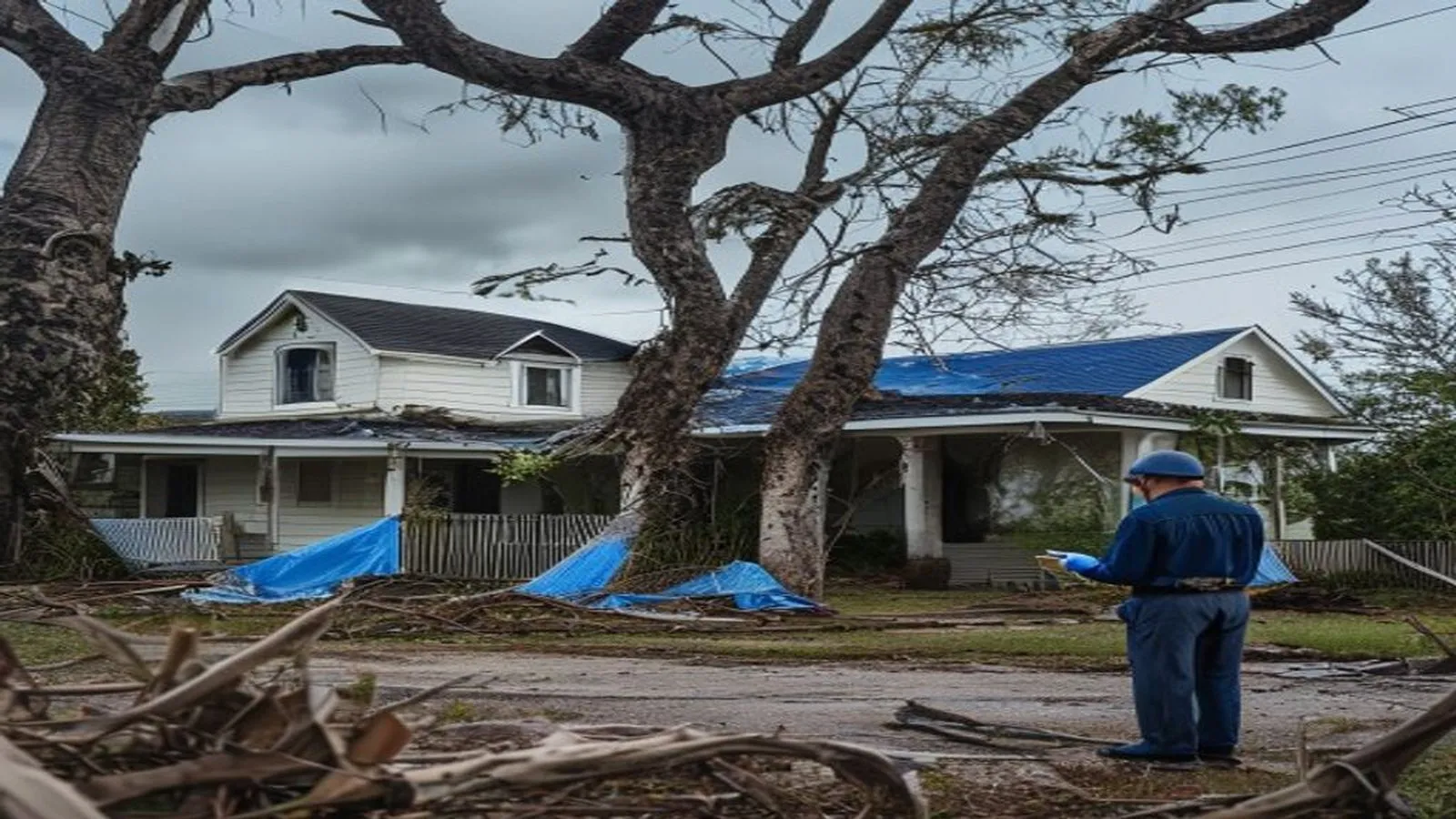
Hurricane Beryl made landfall July 8, 2024, and the resulting damage in Missouri City is still being discovered nearly a year later. The Texas one-year statute of limitations under House Bill 1774 means Beryl-related claims must be filed by July 2025 to avoid denial regardless of damage severity. Here is the process for filing a clean claim.
What Beryl actually damaged in Missouri City
Beryl was a Category 1 hurricane at landfall but produced widespread Cat 2-equivalent wind damage and significant rainfall across Fort Bend County. The damage pattern in Missouri City clustered into four buckets:
- Roof damage from sustained winds. Lifted or torn shingles, vent stack displacement, soffit and fascia separation.
- Wind-driven rain intrusion. Water finding its way through previously-undamaged roof and wall penetrations under 80+ mph wind pressure.
- Tree damage with secondary structural impact. Falling limbs penetrating roofs, tree falls into homes, and root-system disturbance affecting foundations.
- Power loss water damage. Extended power outages disabling sump pumps and HVAC systems, causing secondary water damage and humidity-driven mold growth.
The one-year deadline is the critical constraint
Texas HB 1774 requires most weather-related insurance claims to be filed within one year of the date of loss. For Beryl claims, that deadline is July 8, 2025. Any damage discovered after that date and attributed to Beryl is at significant risk of denial. If you have any reason to suspect Beryl damage on your home and have not had it inspected, do it now.
Step-by-step filing process
Step 1: Document what you can see (before contacting anyone)
- Wide exterior shots of all four sides of the house.
- Roof photos from ground level (and from the roof if safely accessible).
- Close-ups of any visible damage with measurement reference (a ruler or coin in frame for scale).
- Interior shots of any ceiling staining, wall damage, or moisture indicators.
- Attic photos showing any daylight visible through the roof deck or moisture indicators on framing.
- Date and timestamp every photo. Most phones embed this automatically.
Step 2: Schedule a professional inspection
An independent inspection produces documentation the carrier cannot dismiss. We coordinate post-storm inspections within 7 days of any call. The inspection includes roof, attic, exterior walls, foundation, and interior areas where damage may be present. The written condition report becomes a primary document in the claim file.
Step 3: File the claim with your insurance carrier
Call your carrier's claims line. Have your policy number ready. The first conversation establishes the claim number and the date of filing — which becomes the official record for statute-of-limitations purposes. Get the claim number in writing.
Step 4: Adjuster site visit
The carrier assigns an adjuster who schedules a site visit, typically within 7 to 14 days of claim filing. The adjuster inspects the damage, takes their own photos, and produces an estimate. Your independent inspection report and your photos go to the adjuster at this meeting. Disagreements between adjuster findings and contractor estimates are common — your documentation supports the contractor side.
Step 5: Receive the settlement offer
The carrier issues a settlement based on the adjuster's estimate. Often this initial offer is lower than the actual repair cost. The negotiation that follows is supported by your documentation: contractor estimates, independent inspection reports, photo evidence, and any expert reports on hidden damage.
Step 6: Repair and reconstruction
Once settlement is agreed, repair proceeds. The carrier typically releases payment in two stages: initial payment for emergency mitigation (tarp, board-up, water extraction) and second payment after repairs are completed and documented.
What to do if your claim is denied
Texas under HB 1774 includes a pre-suit notice requirement before litigation. If you intend to dispute a denial, the notice process must be followed exactly. Most denials get resolved without litigation through documented re-inspection and additional contractor estimates. The most common reason for denial is insufficient documentation of damage causation tied to the storm date.
Specific Beryl issues we see most often
- Hidden roof granule loss. Damage that does not produce immediate leaks but causes leaks 6 to 12 months later. The connection to Beryl gets disputed if the leak first appears in early 2025.
- Slow-developing soffit and fascia damage. Wind-loosened components that fully separate weeks after the storm.
- Power-loss secondary damage. Mold from extended HVAC failure during the post-Beryl power outages. Often filed as a separate water claim rather than wind claim.
- Tree-root foundation disturbance. Trees uprooted by Beryl that disturbed the root mat under the home, causing slow foundation movement detected months later.
Restoration scope coordination
We provide Xactimate-formatted estimates for the carrier on every Beryl-related job. We coordinate with trusted local roofers for replacement scope. We handle the interior restoration including water extraction, drying, mold remediation, and reconstruction. See our storm damage restoration page for the full response details.
One call for inspection or filing help
If you have not had a Beryl inspection on your Missouri City home, the time is now. Call (832) 479-4406. Inspection within 7 days, documentation that protects the claim, and direct coordination with your adjuster.
Need restoration help in Missouri City right now? Call (832) 479-4406 — live answer, 24/7. Or see our full restoration services, the rest of the blog, or the service area map.