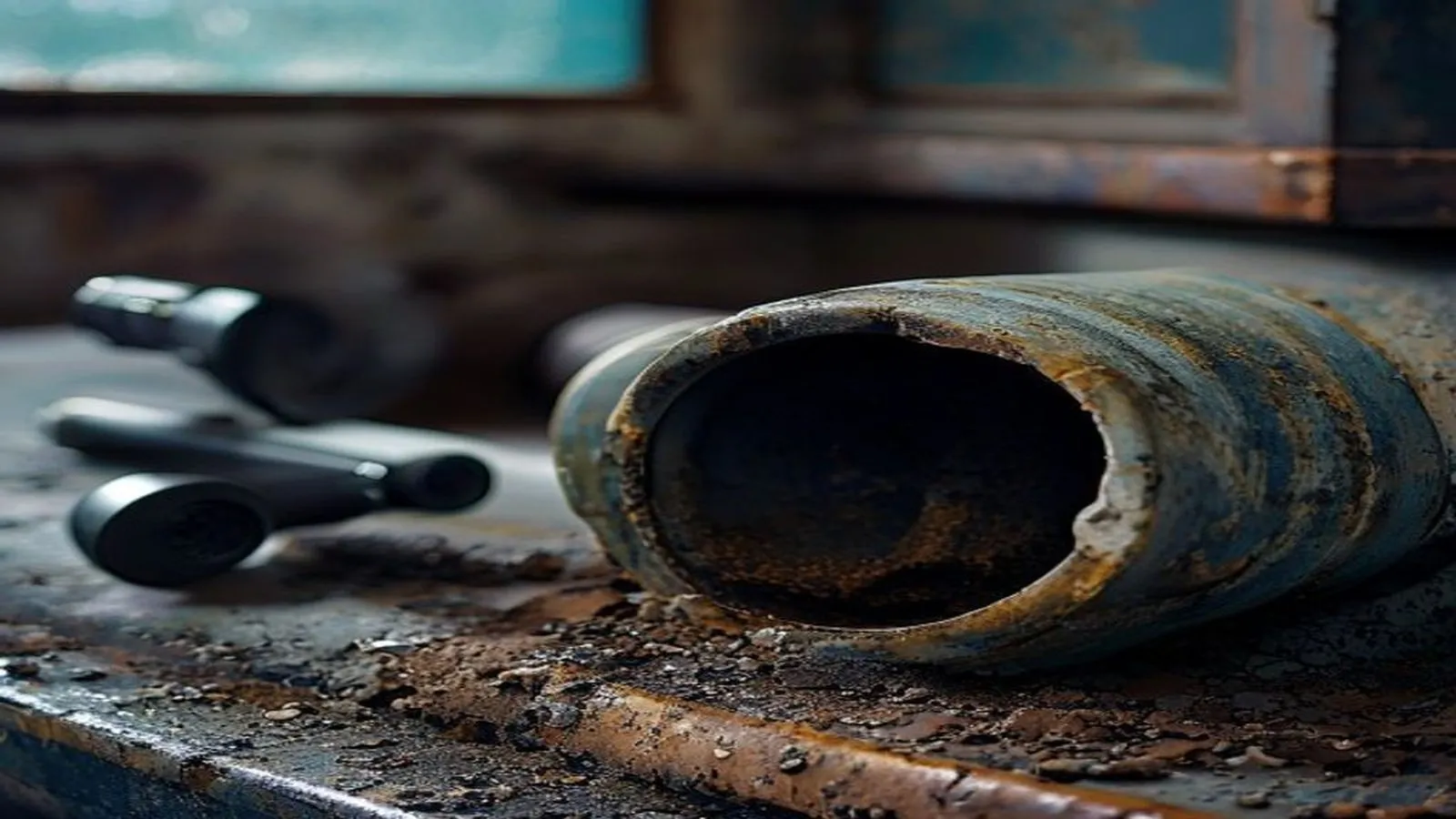
Most Quail Valley homes built in the 1970s still rely on original cast-iron drain stacks. After 50 years those stacks are at or past end-of-service-life. Failure does not announce itself loudly. The first symptom is usually slow drainage at the lowest fixture in the house, attributed for months to a routine clog. Then one weekend the stack fails and sewage backs up through a slab-level guest bathroom.
How cast-iron stacks fail from the inside
The corrosion process is straightforward. Drain water carries household soaps, food waste, hair, and the chemical byproducts of every cleaner ever poured down a drain. Over decades the inside of the pipe develops a buildup that traps moisture against the iron. The iron corrodes. The pipe wall thins. Eventually the wall fails — usually at a horizontal joint where flow turbulence is highest — and waste exits the pipe inside the wall cavity or below the slab.
Warning signs you should not ignore
- Slow drainage at multiple fixtures. A single slow drain is a clog. Two or more slow drains on the same line means restriction inside the stack.
- Gurgling sounds when water drains elsewhere. Pressure equalization in a restricted line.
- Rust-colored water from drains during heavy use. Internal pipe corrosion mobilizing into discharge.
- Sewage odor near floor drains or low fixtures even when nothing is draining.
- Visible water staining on baseboards or low-wall drywall with no obvious supply leak above.
What happens when the stack fails
Sewage takes the path of least resistance. In a Quail Valley slab home that almost always means surfacing at the lowest fixture — a guest bathroom floor, a master bathroom shower drain, or a kitchen sink. Visible sewage is the obvious part. The hidden part is sewage that has migrated under the slab or into wall cavities through the same pipe failure.
What to do in the first hour
- Stop using water. Every flush, every dishwasher cycle, every shower adds to the backup volume.
- Get everyone — kids, pets, you — out of the affected area. Sewage carries E. coli, hepatitis A, Giardia, and norovirus. Aerosol exposure during cleanup is the real hazard.
- Do not attempt cleanup. Mopping spreads contamination and creates airborne pathogen load.
- Photograph the visible contamination from a safe distance for insurance documentation.
- Call. Biohazard-rated crew, full PPE, EPA disinfectants. See our sewage cleanup page or call (832) 479-4406.
Why the plumber and the restoration company are two separate calls
The plumber fixes the failed stack. The restoration company handles the biohazard cleanup, demolition of contaminated porous materials, drying, sanitization, and reconstruction. There is no point rebuilding the bathroom around a failed stack that will fail again in 90 days, so we always recommend a camera inspection of the full drain system before any reconstruction begins. We coordinate the timing with your plumber so the work runs sequentially without dead time.
Insurance coverage gap most Quail Valley homeowners miss
Standard Texas HO-3 policies do not include sewer and drain backup. That coverage requires a separate endorsement, usually capped at $5,000 to $25,000. A full Quail Valley slab-bathroom restoration with biohazard remediation, demolition, and reconstruction routinely runs $12,000 to $25,000 — meaning a $5,000 endorsement covers a fraction of the actual cost. Read your declarations page before you need it. If your endorsement is light, the time to upgrade is now, not after a backup.
Replacement vs spot repair
Once one section of cast-iron stack has failed, the rest of the line is at the same risk. Spot repairs (epoxy lining, single-joint replacement) can buy time but rarely prevent the next failure. Full stack replacement is the durable answer for any home where the original 1970s system is still in place. Your plumber can advise on the best path; we resume restoration after the new line is signed off.
One call covers the rest
If sewage is in your Quail Valley home right now, call (832) 479-4406. Biohazard-rated crew on the way in under 60 minutes. Same crew handles the demolition, the cleanup, the drying, the documentation, and the rebuild.
Need restoration help in Missouri City right now? Call (832) 479-4406 — live answer, 24/7. Or see our full restoration services, the rest of the blog, or the service area map.